Free shipping · 30-day guarantee · Molded and packed in Orange, California
The Gaming Desk Cup Holder.com ← back to the gaming desk page

The gaming desk file

Why drinks tip over on a gaming desk — and what actually holds one at a battlestation

A battlestation packs a hard, crowded desktop, a cloth mat built for a full arm sweep, and sometimes a desk that shakes on its own into one workspace, then asks a can or a shaker cup to stand somewhere in whatever's left over. Here's the physics behind why each of those surfaces works against a drink, what a decade of clamp-on holders and bundled plastic rings still gets wrong, and what it actually takes to hold one through a match that can't be paused.

The math behind the empty strip on a desk like this

A gaming desk isn't undersized so much as fully spoken for. Desk-maker sizing guides converge on roughly 48 to 72 inches of width and 24 to 30 inches of depth, and by the time dual monitors, a keyboard, a mouse, and usually a pair of speakers are arranged on it, most of that depth already belongs to something else. What's left is a strip measured in single-digit inches.

A full-size deskmat claims even more of it. The standard cloth mat measures 900 by 400 millimeters — about 35.4 by 15.7 inches — sized to cover a desk's entire working depth so the mouse can reach every corner without running off the edge. On a 24-inch-deep desk, that one object accounts for most of the usable depth by itself, which helps explain why r/battlestations — a forum with a self-reported membership north of four million — has a recurring thread of people asking for somewhere permanent to put a drink instead of one more coaster.

Two mechanisms behind a battlestation spill

The first is built into how competitive mice get configured. A lower sensitivity setting means covering the same distance on screen takes more physical distance from the hand, which is why low-sens players move from the shoulder and forearm instead of the wrist. That forearm sweeps across most of the mat on an ordinary flick without pausing to check what's standing there, so whatever's parked on the mat's open corner sits inside a moving arc for the match's length.

The second is about light, not motion. A room lit only by a monitor strips away almost every visual cue except the one everyone's staring at, so reaching for a drink mid-match happens by feel. A hand that finds a can by its tapered shoulder instead of its straight-walled base is already pushing from an off-center point — enough on its own to start a tip toward the keyboard about as often as away from it.

A sit-stand desk at full height adds a third mechanism that needs no touch at all. A two-leg frame is structurally a cantilever, and cantilevers lose stiffness the further they extend — which lines up with why standing-desk users consistently describe more shake at full height than sitting height. An open can just rides that vibration for as long as the desk stays raised, creeping across the desktop while both hands stay on the keyboard and mouse.

What actually gets damaged when it goes over

The failure isn't cheap. Custom mechanical keyboards commonly run 200 to 600 dollars, with premium builds passing 1,000, which makes the board sitting closest to the spill often the single most expensive object on the whole desk. One widely referenced troubleshooting thread documents what that costs: CTRL, TAB, and CAPSLOCK stopped registering after a single drink went over, and keyboard communities maintain spill-recovery guides for the same reason a kitchen keeps a fire extinguisher near the stove. Sugary energy drinks are singled out in those guides as the worst case, since the residue stays tacky and keeps corroding contacts long after the liquid has dried.

It doesn't stop at the keys. PC build-support forums document liquid reaching CPU coolers, graphics cards, and power supplies from a single cup knocked over at the desk — components sitting inches below where a drink stands, reachable through open vents that don't ask permission first. The standard advice in those communities is to keep liquids away from the machine entirely, which is easy to say and close to impossible across a six-hour ranked session.

Condensation adds a slower version of the same risk, no knock required. An uninsulated can or cup sweats as it warms toward room temperature, and that water lands somewhere — worked into a laminate or wood desktop as a ring, or soaked into a cloth deskmat inches from a keyboard's underside.

Wondering about your specific cup? The fit database has sourced base measurements for 30+ containers — Stanley, Red Bull, Yeti, and the honest no's.

Four fixes already living on desks like this — and where each one gives out

Clamp-on cup holders are the most common aftermarket answer, and the spec sheet explains most of the complaints about them. The best-known model is rated for desktops about half an inch to two and a half inches thick, with open clearance underneath, and cups up to roughly 3.6 inches across — a lipped edge or thick desktop defeats the clamp outright, and the ring's fixed size leaves a slim can rattling while a wider tumbler doesn't seat.

Several budget desk brands — Bestier, BestOffice, and Costway among them — now bundle their own answer: a small fold-out plastic ring mounted off the desk's edge, usually paired with a headphone hook. It hangs below desk height, outside the natural reach line, and was sized for a standard can, not a shaker cup or a 40 oz tumbler.

Coasters solve a different problem than the one that actually matters here — they stop a ring, not a knock-over, which is why desk-setup forums keep asking for something more permanent than a coaster. A coaster does nothing the moment an elbow actually arrives.

The most committed fix skips accessories entirely: some battlestation builds drill a cup holder into the desktop, the way an IKEA KARLBY or ALEX top gets modified in build threads. It trades a portable problem for a permanent one — a hole saw, a desk its owner is willing to commit to, and one fixed recess in one fixed spot.

What it actually takes to hold a drink here

Line the mechanisms up and the requirements aren't complicated. The desktop is hard with no lip, so grip has to come from friction and contact area, not the surface. The available space is a few inches, not a dedicated slot, so the fix needs a compact footprint instead of a clamp that needs its own edge. And the desk itself sometimes moves, so anything rigid that only survives one bump is the wrong shape — it needs to flex with the vibration and come back level instead of fighting it once and losing.

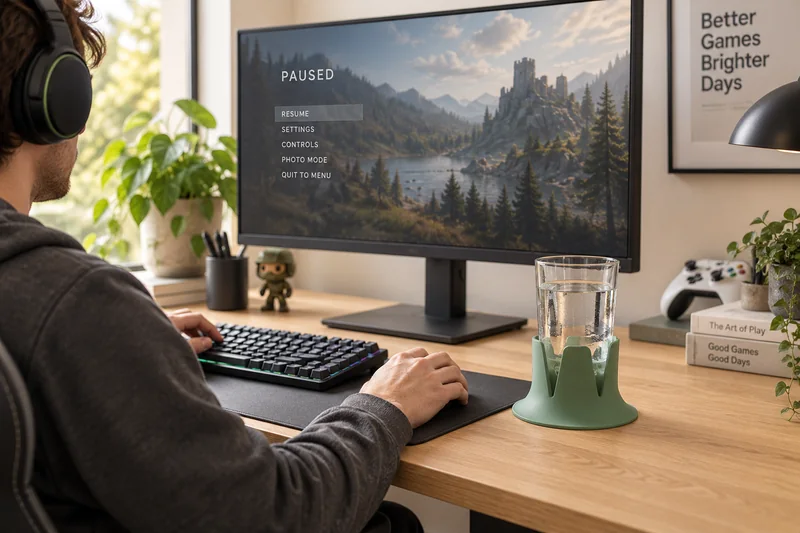
A wide, flexible base with fin grip is built around exactly that combination. Its underside holds position on laminate, MDF, or wood the way a narrow can never can, and flexible fins take hold of whatever's actually on the desk that session — can, shaker cup, or a Stanley 40 oz H2.0 FlowState Quencher — by its bottom inch. It resists tipping through a mouse-arm graze or an elbow bump, holds steady, and settles back level instead of going over. The fit window runs 2 to 3 inches across the base, with the fins flexing to about 3.15 inches for a snug seat — enough range to cover a slim 8.4 oz can's roughly 2.1-inch base at one end and the Stanley's 3.1-inch base at the other, with a standard 12 oz can's 2.6-inch base landing comfortably in between.

None of that gets solved by finding a steadier spot on the mat — on a desk this crowded, there isn't one. It's solved by giving the drink its own wide, flexible base built to grip a hard desktop and flex with whatever the desk does next, which is the whole mechanism behind a can or a shaker cup that holds steady instead of joining the keyboard's spill-recovery thread.

Choose your colors — free shipping

Checkout lives at steadilabs.com, home of the company behind it.