Free shipping · 90-day guarantee · Molded and packed in Orange, California
The Gaming Desk Cup Holder.com ← back to the gaming desk page

The gaming desk guides

The Gaming Desk Space Audit: Where a Drink Can Physically Go

One 27-inch monitor stand plus a standard desk mat is 23.6 inches of depth. The square-inch audit of a gaming desk, and the strip that survives it.

13 min read · 12 sources

The gaming desk space audit: how much desk is actually left, and where a drink can physically go

Nobody measures a desk after it's built. You measure it once, at the store page, and then you spend two years adding things to it — a second monitor, speakers you finally bought, a mat that covers more of it than you expected, a board you saved for. At no point does anyone sit down with a tape measure and work out what's left.

So here is that subtraction, run properly, with real spec numbers instead of vibes. It ends somewhere specific: on most desks, the surviving space where a drink can stand is not where you're currently putting it.

The subtraction that ends at zero

Two numbers do most of the damage, and both are published.

Dell lists the stand footprint on its 27-inch S2725QC at 9.76 inches wide by 7.89 inches deep (Dell). That is not the screen. That is the plastic on your desk.

The XXL desk mat that has become the default — 900 x 400 mm — is 35.4 by 15.7 inches (Padloom), and it is deliberately sized so the mouse never runs off it.

Add the depths. 7.89 + 15.7 = 23.59 inches.

A 24-inch-deep desk — the depth that a lot of budget gaming desks and most 24x48 office tops ship at, and which one desk-depth guide describes as fine for "one reasonably sized monitor on a compact stand" before "equipment placement becomes less forgiving" (Burotic) — has 0.41 inches of depth left after one monitor and one mat. Not one drink. Not one coaster. Four tenths of an inch.

The stand can't move forward to fix it, either. OSHA's computer workstation guidance puts the floor for viewing distance at "at least 20 inches (50 cm)" (OSHA) — pull the monitor toward you and you're trading eyes for square inches.

Go to a 30-inch-deep desk and you get 6.41 inches of clear depth behind the mat. That's real. It's also, as we'll get to, the single worst place on the desk to put a drink, for a reason that has nothing to do with how much room is there.

The width budget

Depth is the brutal axis. Width is where the answer actually lives.

A 48-inch desk minus a 35.4-inch mat leaves 12.57 inches of width, total, split between whatever is left of the two sides. A 60-inch desk leaves 24.57 inches.

Now spend it. A pair of the most common desktop speakers on these setups, the Edifier R1280T, measures 146 mm wide and 196 mm deep each — 5.75 by 7.7 inches (Edifier). Two of them is 11.5 inches of width.

On a 48-inch desk, your entire leftover width is 12.57 inches and your speakers are 11.5 inches wide. That is the whole story of the small desk in one line: the leftover is exactly two speakers, and you own two speakers.

On a 60-inch desk you keep about 13 inches of genuinely open width after the same speakers, and it lands as a strip on each flank of the mat. That strip is the entire subject of the rest of this page.

A smaller board does not buy you drink space

This is the intuition that costs people the most time. Keyboard widths are roughly 17.5 inches full-size, 14.0 TKL, 12.5 for a 65%, 11.5 for a 60% (KeebsForAll). Going from full-size to a 65% frees five inches.

It frees five inches on the mat. Which means it frees five inches of mouse travel, and the mouse takes them immediately — that is the actual reason people move to compact boards. Your drink situation is unchanged. What you bought was runway.

Worth doing the arithmetic on that runway, because it explains the next section. Across a running sample of roughly 690 professional VALORANT players, prosettings puts the average at 267 eDPI and 45 cm per 360 (prosettings). 45 cm is 17.7 inches. A full-size board on a 900 mm mat leaves 17.9 inches of mat beside it. A player at the pro average, turning a full 360 in one stroke, uses every inch of it.

The mat is a scale drawing of your exclusion zone

The XXL mat did not become standard by accident. Padloom's sizing guide is blunt about who it's for: an FPS player "running 400-800 DPI with a large in-game sensitivity" needs "roughly 50-60cm of horizontal mouse travel — enough for those 180-degree flicks without lifting."

Run that against the pro average. At 45 cm/360, a 180-degree turn is 22.5 cm — 8.9 inches of mouse travel in one motion, from the shoulder, without looking. The mat is 35.4 inches wide because that is what those motions cost, plus the board.

So the mat is not decoration and it is not a surface. It is a printed, to-scale map of the area your forearm owns during a fight. Anything standing on it is inside the envelope by definition, and the envelope is invisible to you at exactly the moments it matters, because you are looking at the screen.

If your mat has any hours on it you can usually see this: cloth polishes where the mouse and the forearm ride. The shiny patch is your envelope, measured empirically, for free. Look at it before you decide anything else.

Rule one falls out of this and has no exceptions: nothing stands on the mat.

The second constraint nobody thinks about: the transit line

Here's the part that makes the "safest" spot the wrong one.

Every drink on a desk has two geometries, not one. There's where it stands, and there's the path it travels twice per sip — up to your mouth and back down. Draw that line. If it crosses the keyboard, the board is under your drink several dozen times a session, at the exact moments your grip is worst: mid-round, one-handed, dark room, eyes elsewhere.

Sugary spills are the ones that don't forgive. Keyboard maintenance guides are uniform about it — water leaves no residue, but "soda, energy drinks, coffee with sugar, juice — anything with sugar or acid is worse because it leaves sticky residue even after drying," and "that residue corrodes contacts and gums up switches over time," with the failure sometimes showing up weeks later, as MKB Guide puts it, when "the sugar residue hardens and starts affecting the switch mechanisms" (MKB Guide). Recovery is an isopropyl rinse and 48 to 72 hours unplugged, on a board that may already be quietly corroding.

The transit line matters as much as the standing spot, and it's the reason the biggest patch of open desk is disqualified below.

The six candidate zones, ranked

Zone A — behind the mat, between mat and monitor stand. Exists only above about 23.6 inches of desk depth. On a 30-inch desk it's a 6.4-inch shelf and it is genuinely outside the sweep. It is also directly behind the board, which means every sip lifts a full container up and back over the keyboard and then sets it down over the keyboard again. Best standing spot, worst transit line. Net: no.

Zone B — outboard of the mouse side (the right flank, for most people). This is where the drink already is. It is the open corner, it's on your dominant side, and it's the one place your hand is already going. It is also the sweep side — the flank where 8.9 inches of forearm motion happens per 180, and it requires the mouse hand to leave, which is the one hand that cannot leave during a round. Everything about Zone B is habit, and every part of the habit is backwards.

Zone C — outboard of the non-mouse side (the left flank). The winner, and for a reason that isn't obvious until you've said it once: the WASD hand is the hand you can actually spare. You can hold an angle with a thumb and two fingers; you cannot aim without a mouse. A drink on the left flank is reachable by the hand that has slack, sits outside the sweep entirely, and — if you place it forward of the keyboard's front edge line rather than level with the board — keeps the transit line off the board completely. Three constraints, one spot, and it's the flank most people leave empty.

Zone D — the front strip, between the mat's front edge and the desk edge. On a 24-inch desk this is usually zero. Where it exists, understand what changes: the failure mode at an edge is not tipping, it's falling — onto carpet, the tower, or the power strip. Nothing that sits on a desk fixes a fall off one. Stay a couple of inches inboard and it becomes Zone C or D-adjacent; sit on the lip and you're relying on luck.

Zone E — the monitor riser or speaker shelf. Never. It is the one location on the desk that is directly above the keyboard. A tip there doesn't land beside the board, it lands on it, and most bundled risers are narrow enough that a 16 oz energy can overhangs the back edge anyway.

Zone F — the floor beside the chair. The honest fallback, and its costs should be stated plainly rather than sneered at: it's below eye line, it's inside the swept path of five casters, and drinking from it means fully leaving your posture mid-match. It's what people do when the audit above comes back negative. It is not a solution, it is a surrender with a good reason behind it.

Run the audit yourself: five minutes, one tape measure

  1. Measure the top, not the frame. Width and depth of the actual work surface. Sit-stand tops often overhang the frame; the frame is not what you're placing things on.
  2. Measure your stand's footprint, not your screen. Put the tape on the base plate, front to back and side to side. On a 27-inch this is commonly around 8 inches deep; on a 34-inch ultrawide, expect more. Subtract it from depth.
  3. Subtract the mat's depth. 15.7 inches for a standard 900x400. Whatever is left is your real clear depth. If it's negative, that's not a mistake — it means the mat is already tucked under the stand, which most of them are.
  4. Mark the envelope. Look for the polished patch, or play one match and then set the mouse at the extremes it actually reached. Tape the outer limits. That rectangle is off the table for anything but the mouse.
  5. Find your reach arc. Sit in playing posture, left hand on WASD, and sweep it outward without moving your shoulder or your eyes. That arc is your one-handed reach envelope. Anything outside it will be reached for with a lean, and a lean is when things get knocked.
  6. Overlap them. Off the mat, inside the reach arc, with a transit line that doesn't cross the board. On most desks that intersection is a single strip on the non-mouse flank, several inches wide.
  7. Check it against the actual container. A standard 12 oz can is 66 mm across the body — 2.60 inches (Crown). A slim energy can is 53 mm, or 2.09 inches, and 133 mm tall (Crown) — the narrowest base and one of the tallest bodies on the desk, an aspect ratio of about 2.5 to 1 against the standard can's 1.85 to 1. A 40 oz tumbler wants meaningfully more. And measure for the grab, not the base: you need clearance for fingers around it in the dark, which is roughly an inch more per side than the container itself.

What the surviving strip still has to survive

Say the audit comes back with a strip. It's off the mat, it's reachable, the transit line is clean. Three things still happen there.

Grazes. Not the mouse sweep — you've designed that out — but the elbow on the way to the headset, the headset cable dragging as you lean back, the reach across for the phone. Low energy, lateral, and constant.

Vibration, if the desk goes up. This is measurable and worse than people assume. Btod's WobbleMeter test of an UPLIFT V2 on a 30x48 top scored side-to-side wobble at 9 at seated height (30 inches) and 37 at 46 inches, with front-to-back rocking going from 17 to 45 — a band their scale describes as "fair to bad," where most users will notice the motion (Btod). That's a well-regarded frame. Every keystroke puts something into an open can for the length of a standing session.

Condensation. No knock required. A cold uninsulated can on laminate leaves a ring; on a cloth mat it leaves a damp patch that doesn't bead and doesn't evaporate quickly, a few inches from a PCB.

The relocation answers, measured

Every common product in this category tries to solve the audit by moving the drink off the desk. Their limits are geometric and published.

Clamp-on holders. The best-known one, UPLIFT's, clamps "to desktops between 0.5" and 2.5" thick," takes cups up to "3.6" diameter," has a 3.4-inch cage and a 5 lb ceiling (UPLIFT Desk). Those are honest specs and they define who is excluded: thick slab tops, tops with an apron or a lip, tops with a crossbar or a drawer under the edge, and any edge that isn't a clear straight run. It also relocates the drink below desk level and outboard, which lengthens the transit line and makes every reach a blind one.

The plastic ring your desk shipped with. Fixed small diameter, hung off the edge, below the work surface. It was sized for a can in about 2009 and has not been resized since.

Drilling a recess into the top. A hole saw, a desk you own outright, one fixed diameter, one permanent position, and no way back if the layout changes. It's a renovation.

Coasters. Correct answer to condensation. No answer at all to a graze.

The other way to buy square inches

There's a category the audit points at that isn't relocation: leave the container where the audit put it, and change how much tilt it can absorb before it goes over.

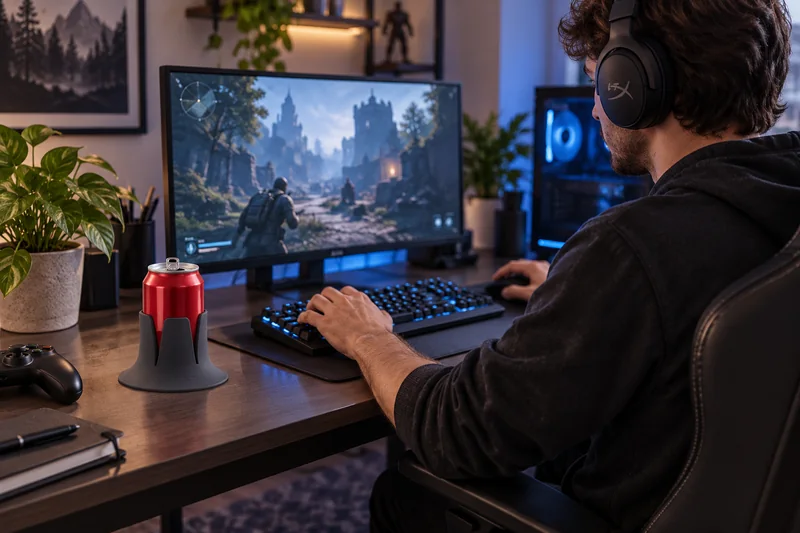
That's the whole design premise of the Steadi holder, and it's worth stating mechanically rather than as a claim. It's a single piece of Shore 85A TPU — not silicone — 2.8 inches tall, with a fixed base 5.2 inches across. The base does not expand, contract or deform; the fins flex to grip the container's bottom inch. Because the base of support under the drink is now 5.2 inches wide instead of the can's 2.6, the container's centre of mass has to travel considerably further horizontally before it passes outside that base — so it takes a much larger tilt to put it over. The TPU's tack resists sliding on laminate, wood, or the cloth of a mat.

The audit charges it honestly, though: 5.2 inches is a real footprint, and this whole page has been about how few inches you have. On a 48-inch desk with a standard mat, your total leftover width is 12.57 inches split across both flanks — a 5.2-inch base fits a six-inch strip, and not much less. On a 60-inch desk it's comfortable. Measure before you assume.

What it does: it leaves the container where the audit put it and settles in on the desktop, on the mat's cloth, or on a riser shelf without a clamp, a bracket, a strap or a hole. Whether your particular can, shaker or tumbler seats in it is a question of that container's base diameter, so measure the base of the one you actually drink from and check it against the current fit page before you order. On a sit-stand frame it goes up with the desk and doesn't care about the wobble score.

What it doesn't do, stated plainly, because this audience checks: it is not a mount, a clamp or a restraint. A handled mug is an honest no — the handle lands exactly where a fin needs to grip. It doesn't insulate and it doesn't seal, so a lid is still your answer to condensation and to a full inversion. A deliberate full-speed strike from a forearm still wins; what it changes is the graze, the nudge, the cable drag and the blind reach, which is the ordinary way a drink goes over on a desk. And it sinks rather than floats, which matters on a boat and not here.

It's molded in Orange, California, patent pending, dishwasher safe, and carries 90 days from delivery with free returns — used is fine, which is the only version of a guarantee that means anything for something you're supposed to test next to a $400 board. Checkout is at steadilabs.com.

Put it in Zone C if the audit gave you Zone C. If your only surviving space is on the mat, it will hold there too — the TPU grips cloth fine — but understand you've traded geometry for grip, and geometry is the stronger of the two. Off the mat is better.

The short version

Run the numbers on your own desk before you buy anything, including this. One 27-inch stand and one standard mat account for 23.6 inches of depth, which is a 24-inch desk. The mat is a to-scale drawing of the area your forearm owns. The dominant-hand flank, where your drink currently is, is the sweep side and needs the one hand that can't leave. The far shelf behind the mat is safe to stand on and terrible to drink from.

What survives is usually a strip on the non-mouse flank, forward of the board's front edge, a few inches wide. That's the answer to where a drink can physically go on a gaming desk. Everything else is arguing with a tape measure.

Wondering about your specific cup? The fit database has sourced base measurements for 30+ containers — Stanley, Red Bull, Yeti, and the honest no's.

Sources

  1. Dell — Dell lists the stand footprint of its 27-inch S2725QC monitor as 9.76 in wide by 7.89 in deep
  2. Padloom — The 900x400 mm XXL desk mat is 35.4 x 15.7 in and is the de facto standard; the page says an FPS player "running 400-800 DPI with a large in-game sensitivity" needs roughly 50-60 cm of horizontal mous
  3. prosettings.net — Across a running sample of ~690 pro VALORANT players the average eDPI is 267 and the average cm/360 is 45 cm
  4. KeebsForAll — Keyboard widths: 60% 11.5 in, 65% 12.5 in, TKL 14.0 in, full-size 17.5 in
  5. Occupational Safety and Health Administration — OSHA: work surface depth should allow viewing the monitor at a distance of at least 20 inches (50 cm); frequently used devices should stay within the primary work zone
  6. Burotic — 24-inch desk depth suits one monitor on a compact stand before equipment placement 'becomes less forgiving'; 30 in is the more versatile depth for dual/ultrawide
  7. Edifier — Edifier R1280T desktop speakers measure 146 x 234 x 196 mm (5.75 x 9.2 x 7.7 in) each
  8. Btod / BTOD.com — UPLIFT V2 WobbleMeter results: side-to-side 9 at 30 in and 37 at 46 in; front-to-back rocking 17 at 30 in and 45 at 46 in, a 'fair to bad' band where most users notice motion
  9. UPLIFT Desk — UPLIFT Clamp-On Cup Holder clamps to desktops 0.5-2.5 in thick, fits cups up to 3.6 in diameter, 3.4 in cage, 5 lb max
  10. Crown Holdings — Standard 12 oz / 355 ml beverage can body diameter 66 mm (211), height 122.22 mm
  11. Crown Holdings — 8.3 oz / 250 ml slim can body diameter 53 mm (202), height 133 mm
  12. MKB Guide — Sugary spills leave residue that corrodes contacts and gums up switches even after drying; recovery is an isopropyl rinse and 48-72 hours unplugged

More from this guide series

Choose your colors — free shipping

Checkout lives at steadilabs.com, home of the company behind it.